In this episode, we sit down with Blake Erickson, founder of Scaling.com and co-author of The Science of Scaling, to explore what it takes to lead exponential business growth. Erickson shares research-backed insights on successful founders, building high-performing teams, attracting top talent, and creating systems that allow businesses to grow beyond the founder. We discuss common scaling challenges, including lack of focus, poor delegation, and trying to control every decision. The conversation also explores the importance of character, accountability, humility, and strong leadership. Discover how founders can overcome obstacles, develop a winning culture, and build a lasting business that grows sustainably.
Episode Highlights & Time Stamps
4:04 Why Blake Wrote The Science of Scaling
6:12 The Founder’s Traits Behind Exponential Growth
8:04 Why Focus Beats Addition and Control
11:01 Separate High-Impact Work From Noise
13:20 Building the Team That Can Scale
14:44 Becoming a Founder A Players Want to Follow
17:38 Why Great Doers Don’t Always Make Great Leaders
19:47 Humility, Feedback, and Founder Growth
21:26 Balancing Care for Employees and Customers
25:04 Building an Asset That Compounds
26:43 Key Lessons for Exponential Growth
Podcast Transcript
Blake Erickson:
[0:00] I think it all comes down to character and character is a thing that you can’t fake for over over the long run.
Blake Erickson:
[0:06] And so, like I said from the beginning, people people want to win. And the best way people know how to win is go play the game with winners. And so your track record is important. Have you have you shown that you can go create results one, but even more importantly, your track record of character is very important. Do you keep your word? Do you have a reputation that you deliver? Do you have a reputation that when you say you’re going to do something, you do it? Do you have a reputation that you’re always going to be honest and integrable in your dealings? Do you take care of your people? Do you love them? Do you actually make them feel like they can expand and be better and develop because they get to be around you and learn from you? And then last, I think one of the most attractive characteristics of these powerful leaders is do you force people to play at a level that they’ve never even considered possible?
Gene Hammett:
[1:02] If you’re a founder who’s built something real and now your business can’t grow without you in the middle of everything, you’re in the right place. I’m Gene Hammond. This is Growth Think Tank, where founders who are ready to stop being the ceiling of their own company come to think differently, lead better, and build a company that doesn’t need them. This is the longest running leadership podcast in the world. Hundreds of Inc. 5000 CEOs have told their stories here. Let’s get to it. Today, we’re going to talk about exponential growth, specifically how founders lead exponential growth. We’re going to look at the mistakes they often make. We’re going to look at the core things that they have to get right as they navigate through the challenges, the headwinds of driving exponential growth. Today’s special guest is Blake Erickson. He is a co-author of The Science of Scaling, which has been a very popular book out there. If you keep listening to this, he gives you a chance to download it for absolutely for free. I think you should take him up on it because if you really do want to grow your business, have exponential growth, then you want to make sure that you take every chance to learn about it from others. It’s not just me, but I’m really advocating for you to read other books around this.
Gene Hammett:
[2:13] I am in the midst of reading that book right now, but I wanted to have the interview in here with a little bit of fresh perspective without knowing about the book to serve you with my curiosity. Some of the things that we dive into with Blake on how founders lead exponential growth is the mistakes that get in the way.
Gene Hammett:
[2:32] Those mistakes are probably something you’re experiencing right now, but we do talk about them so that you’re aware of them and that you can decide how to move forward. We also look at the core principles of how a founder is able to create the right team, the right focus, and the ability to leverage their way to exponential growth. All of those elements wrapped up into a great episode today. My name is Gene Hammett. I am a founder coach. me and my team focus on smaller companies, probably 30 plus employees, helping them truly scale their businesses through leadership. So if you feel like leading your company is getting harder, you’re having more people problems, you’re having to work harder, you’re making more decisions that they should be making, then it all comes down to the right leadership. And if you’re curious about the work that we do, I want to make sure that you know that our free book is Get Founder Freedom. You can download it for free. Go to getfounderfreedom.com and it’s yours. We will include some bonuses with you for that and really help you and support you any way you need to. And it’s a short read. You can actually read it in about an hour. But it’s very powerful from a standpoint of getting you to think more like a leader that creates freedom, not someone who just drives the company forward, the firefighter. And that actually was one of the mindsets that gets in the way. All that being said, download it now at GetFounderFreedom.com. And here’s the interview with Blake.
Gene Hammett:
[4:01] Hey, Blake, how are you?
Blake Erickson:
[4:02] Amazing, Gene. Pumped to be with you today.
Gene Hammett:
[4:04] Well, I’m excited to have you here too. Excited to talk about the book that you guys out, The Science of Scaling. Give us a quick rundown of why you had to write this book.
Blake Erickson:
[4:15] So my co-author, Dr. Benjamin Hardy, a couple of years back, we’ve 2023, wrote a book called 10X is Easier Than 2X, which blew up entrepreneurial community. And it was kind of this first thought of, wow, what if actually going for bigger goals, bigger scale, simplified the things that we do as founders. And due to the reaction to that book, we realized that we just kind of scraped, he just kind of scraped the surface. And so when we got together to collaborate, we said, let’s go, let’s go really own this from a scaling standpoint. Let’s take this to the furthest extreme in research possible and truly identify what is the science behind exponential growth. And there’s 36.2 million companies in the world, and very few of them are actually experiencing exponential growth, which is 100%, 200%, 300% growth. And very commonly, founders are stuck in this frame of mind that a successful year is 12% growth or 15% growth. And we wanted to eliminate that paradigm and create the formula and the how-to of how to actually go exponential rather than incremental. So that’s where it came from and that’s where we spend every single waking hour studying, teaching, and advising.
Gene Hammett:
[5:23] Well, you probably didn’t know this, Blake. I know I told you that I’ve been doing this for a long time. This is like the 1300th episode of the podcast. We’ve had about 800 founders or more from the Inc. 5000.
Blake Erickson:
[5:36] Wow.
Gene Hammett:
[5:37] When I started doing this, a lot of clients were small on the podcast. And then maybe about eight years ago, I had a few clients that made the Inc. List. And I got really fascinated about fast growth companies, much like you guys did. And the exponential growth. Now, not everyone had exponential growth. It’s on the Inc. 5000, but a lot of them do. I’ve had the number one companies and the number two and fours, 30,000% growth over a three-year period. And so I studied that. I would love to know from your perspective, like what are the common elements of a company that performs with this exponential growth?
Blake Erickson:
[6:13] You know, what’s really interesting is we talk about the company, but nine times out of 10, it’s actually more about the founder and how the founder thinks and how the founder operates. And so Reid Hoffman once said, no matter how amazing your ideas or your product is, scaling is impossible without A players. And that’s true also for the founder. And so what we’ve seen is the ones that do exponentially scale, which is a rarity, the ones that truly go experience that growth. One, the founder is incredibly resourceful. They have the ability, not just hustle, not just get scrappy, but, but they’re persuasive. They can go attract talent because they have a winning track record. They’re a winner. They’re people. They are a person that people want to bet on so they can go get the talent they need to, uh, they know how to problem solve. They know how to pivot. And three, I would say, uh, they look, they always look at their business in terms of leverage. They’re always trying to play the long game. And what I mean by that is most founders get caught in this wheel of doing where I got to solve this I’m gonna do this. I got to step in here, etc But the best founders look in terms of leverage say, okay Who can solve this or what process system can be put in place? So I don’t have to get stuck here And so they’re constantly scaling themselves, which becomes a byproduct of their company being able to scale, So that’s out of out of a ton Those are a couple to to name to name a few But the best people, the best founders are the best companies.
Gene Hammett:
[7:43] You know, we could spend the whole episode just on what you just talked about right there, just taking it and unraveling some of those things. So I think I want to do that with you, Blake. I know the science of selling is really about the company growing, but I always feel like the driving force inside of any company is that founder’s ability to lead others into a new future.
Blake Erickson:
[8:03] Yep.
Gene Hammett:
[8:04] What are some of the mistakes that founders make as they try to scale a company like 100 times in a year? 100%.
Blake Erickson:
[8:13] Yeah, first and foremost is they try to scale by playing the game of addition, which means, hey, let’s add more, let’s do more, let’s say yes to more things, let’s add more opportunities, more products, etc. And the game of addition is the game of stagnation. It is inevitable for you to continue to say yes to things. The more things you say yes to, the harder it is going to be to scale. And the ones that do scale, what they do is they do less things better.
Blake Erickson:
[8:42] They very rarely say yes. Steve Jobs once said innovation is saying no to a thousand things. And so the best founders in the world are phenomenal at being rigorously disciplined and being focused. And it’s so easy. This is, I mean, I’ve experienced this a hundred times in my life. I’m sure you have too, Gene. But it’s so easy to get distracted by good opportunities. But the best founders are just saying they’re always a no unless it’s the thing that’s going to help them get to their goal. Secondly, founders really struggle because they always try to serve two masters. And here’s what I mean by that. Everyone says they want to scale. The founder gets in the company, says, hey, I really want to scale. But then he doesn’t want to let go of control of his business. He wants to micromanage. He wants to be in every single seat and every single decision. That’s serving two masters. You can either choose control or you can choose scale. Or another founder just really wants to protect his lifestyle. And so his lifestyle is really, really important to him. and uh he doesn’t he doesn’t want to, maybe put the money in and so he’s choosing security or lifestyle, over scale and so we do this all the time where we’re always we’re always trying to serve two masters in in our business whether it’s our pride or ego whether it’s control whether it’s lifestyle whether it’s security, and the founders that scale, continuously say no scale.
Blake Erickson:
[10:05] Is the master I’m serving, and I serve no other master. And I have no sacred cows. And so there’s nothing, there’s nothing that I’m more attached to than making sure that my business grows. And that might sound overly rigorous. There’s, you got to take care of your people, you got to lead effectively, etc. But you can’t let competing internal agendas in that you have as the founder, get in the way of you scaling.
Gene Hammett:
[10:32] I see quite often a lot of companies, let’s say they have a hundred employees and they’ll feel like, because they have the different departments and they have heads of this good, good executive teams that they’re like, well, we’re just going to do three projects, each team. And, you know, you may have 16 projects going across a quarter that stretches out into two quarters and three quarters and you’re making progress, but you’re not, you’re not having the kind of growth. That’s a, that drives a hundred percent growth. It’s, It’s the incremental stuff.
Gene Hammett:
[11:01] How do you address that limitation with these different teams that are, well, you know, we’ve got so many people, we’re going to, we’re just going to do these, we got to do all these projects,
Blake Erickson:
[11:09] Man. It’s so good. So one of the things that Elon Musk is phenomenal at, whether you love him or hate him, is he is all signal and no noise. And the definition of signal is we only spend time on the things that actually are going to get us the result. And we only spend times on things that create exponential return, not marginal return. And so if you look in your business, if you’re the founder with 100 employees and you’ve got 16 projects going, ask yourself how many of those projects are going to create an exponential impact or return and how many of them are going to create marginal return. I’m going to guess that 15 of them are going to create marginal returns. And there’s maybe one out of the 16 that’s actually going to make a significant impact to the company’s growth. And so at the end of the day, it comes down to, once again, this discipline and rigorous focus of, what am I optimizing for? And am I focused on activity? Or am I focused on achievement? Because when you become really achievement focused and results oriented, a lot of the things that you’re currently doing don’t make sense to do. A lot of things that you’re optimizing for don’t make sense to optimize for, because you’re solely focused on achievement, not activity. And so the best founders in the world, Gene, are just really, really good at filtering out what is noise and what is signal, what actually is going to create the result and what is not. And I’m going to say no to everything that is not going to create that result.
Gene Hammett:
[12:39] I really can appreciate you going through this because I’ve been, I’ve been on the front lines with my clients for years doing this. And I say it so many times and then they go,
Blake Erickson:
[12:49] Yeah, but the justification is where it all gets lost.
Gene Hammett:
[12:53] Man. And I get it and I hear, and I listened to them. And then I say, I have to give the hard answer. I have to tell them that this is not going to give you the outcome. And I want to go back to something you said, Blake, though, because I think a lot of people, they get to a certain point with their business because they’ve hired pretty good people. Some of those people have transformed to be A players. Some of them, they’re carrying, they’re dragging some of those people.
Gene Hammett:
[13:21] And it is time and time again, and I see this at scale, in order for you to double your company, you have to change the way you lead, but you also have to change some of the team players inside this. Are you seeing that with your companies as well?
Blake Erickson:
[13:36] Every single one. Every single one. The most important lever to pull to scale, is the people that you have on your team, whether it’s letting go of them and bringing in the new ones or just finding the roles that aren’t currently filled. But 100%, I will say this to the day I die, even in this world of AI gene, the people you have on the bus ultimately determine the success and scale of your company.
Gene Hammett:
[14:06] I agree with you. Now, we won’t go into this, but I will tell you a lot of people we’ve had on that are using AI in a very powerful way are not saving jobs. They’re actually hiring more people. They’re just moving faster because of AI. And that’s happening at scale for the bigger companies. I just interviewed a company that is approaching a billion in valuation. And I’ve had him on the podcast years ago. It’s a completely different company because of this. And I said, are you reducing headcount? And he goes, no, we’re scaling up. with head count. But we’re using AI in a way that speeds everything up.
Blake Erickson:
[14:42] Yeah, so good. So good.
Gene Hammett:
[14:45] So you talked about the A players. I’m going to go back to one of the other things you said, because I just thought it was really powerful. Attracting the right talent, being the kind of founder that people want to bet on. I remember when I was in, let’s say, corporate America, i was looking for skills and i was really excited to work for for one of those early dot coms in 1999 blake you’re too young to know what it was like in 99 but it was the wild wild west yeah of internet and i got to work with a startup we did not go public but i was i would have bent over backwards for for everyone on that team and we did we to overcome everything we did how do you take a business and become the kind of founder that that really does attract those eight players
Blake Erickson:
[15:32] I think it all comes down to character and character is a thing that you can’t fake for over over the long run and so, uh like i said from the beginning people people want to win and the best way people know how to win is go play the game with winners and so your track record is important, have you have you shown that you can go create results one but even more importantly your track record of character is very important do you keep your word.
Blake Erickson:
[16:01] Do you have a reputation that you deliver? Do you have a reputation that when you say you’re going to do something, you do it? Do you have a reputation that you’re always going to be honest and integrable in your dealings? Do you take care of your people? Do you love them? Do you actually make them feel like they can expand and be better and develop because they get to be around you and learn from you? And then last, I think one of the most attractive characteristics of these powerful leaders is do you force people to play at a level that they’ve never even considered possible? And the best leaders, the best founders that I’ve seen, Gene, have this capability of just seeing possibility instead of limits, and they take everything to like the biggest level, and they’re the biggest thinkers in the room and so the consequence of that when you’re around that as a team member whether a leader or just an employee that rubs off, and it begins to help you think differently psychologically and transform and uh and become better so those are some of the things that come to mind when i think about what is what is an attractive founder? How do they get the most attractive people? And then it starts with themselves.
Gene Hammett:
[17:11] If you’re listening to this show, chances are you’re a founder who’s built something significant, but you’re still too deep in the day-to-day to see the path forward. That’s exactly what the founder freedom strategy call is for. It’s free. It’s 30 minutes with me personally, and we’ll pinpoint exactly what’s keeping you stuck and what you need to do about it. Book your time with me at my personal URL, schedulewithgene.com. Now back to the podcast.
Gene Hammett:
[17:39] I’m going to get this. There’s a couple of stories that I have with clients and I’m not going to mention names, confidentiality, but they’ve hired good people that were supposed to be good managers. Yeah, I know how to develop a team around this department. And they end up being really good people from a doer standpoint. They work hard, but they’re not developing their team. So they might be an A player in a sense of doing work and maybe solving a problem. But it comes down to developing the team around them. They’re playing at a level C. How do you navigate that with your founders?
Blake Erickson:
[18:14] Oh, man, that’s tough. It’s tough. So I was in the sales world for a really long time. And what most people typically do is when they have a really good salesman, what do they do they promote they promote sales leader right.
Gene Hammett:
[18:26] And it’s it it almost fails every time i’ve ever seen
Blake Erickson:
[18:30] It rarely works rarely works so this the same is true all over right and so, An extraordinary leader is so rare. It’s so rare to have somebody that people respect, admire, want to be led by, can lead from the front, can have good character. And so how do we deal with it? Is one, are you leading from the front? Are you showing the example? And then two, are you being thorough enough in your hiring process to make sure that you are getting that? And so that may sound like overly simple, but just don’t fall into the fallacy that if someone’s good at the thing, that doesn’t mean they can lead at the thing. Find someone that’s an amazing leader, probably more important than even being good at the thing. I’d put more stock into that.
Gene Hammett:
[19:16] I agree with you on that. I know it’s counterintuitive to a lot of people because they’re like, well, they’re going to lose respect or credibility if they’ve never done it before. And I said, if you look at companies like Google and whatnot, which I’ve interviewed a lot of people about this, they have people that don’t code that manage projects because they’re good at the other elements that are necessary for a team to perform at a high level. And it takes both sides for the company to those projects to be successful.
Blake Erickson:
[19:45] That’s an invaluable skill.
Gene Hammett:
[19:47] Blake, you mentioned another element from a founder standpoint is being able to pivot, problem solve. Yeah. Give us a little bit more depth around that.
Blake Erickson:
[19:57] I’m telling you the number one reason why people don’t scale or companies don’t scale is due to the founder’s pride. The ego, the ego and pride that founders have keeps them so much from being able to get to the levels that they could get to because it’s shown in all their decision making. Maybe they don’t want to promote someone because they might be better than them. Maybe they don’t want to recruit somebody because they might be better than them at the thing. Those those types of mentalities and thoughts are going to absolutely ruin you long term. I think about the amount of humility it takes to receive feedback. Hey, don’t say this, or we could do this better in this meeting, or your product’s not good in this area. And if you’re not humble to that feedback, you’re just will never improve. And in order to scale, you must improve. And so you have to be willing to hear those things and actually not even willing to hear them, Gene. You must be on offense to seek them out. Where can I get better? Where can we get better? Where can the product be better? Where can we deliver better? Where is our process bad? Where is our system bad? Give give the feedback seek after the feedback and so founders founders go so fast when they get out of this, immature pride and ego phase they can go so fast and when they stop caring so much about looking good, and they commit way more and caring a lot more about being good that’s when that’s when the transformation begins to take place.
Gene Hammett:
[21:27] I want to talk for a moment here about team. I probably should have asked this a little bit earlier, but it just hit me. I’ve interviewed a lot of people. I bragged about 800 founders. And I will ask what I would call the impossible question. Interesting where you come down on this. It’s impossible in a sense that it takes both of these things for success to happen. But I will ask founders, as a leader, what’s more important, your team members or your customers? Really good question these are not big companies corporate behemoths not you know they’re not home depots and coca-colas these are you know the tried and true founders with like 30 employees or 100 employees what do you think they say more often
Blake Erickson:
[22:13] I’m gonna say the customers it is what the is what they say yeah i could be wrong but i’m of the belief that it’s the team most of the time most of the time.
Gene Hammett:
[22:23] Based on my data, 93% say it’s employees.
Blake Erickson:
[22:27] Oh, wow.
Gene Hammett:
[22:28] These are fast growth companies. They’re not public. Good. Great stuff. I’ve heard every other excuse and I never take that at a surface level. I will ask them why. And I’ll just give you a couple of things. You’ll get it. Hey, if I take care of my employees, they’ll take care of our customers. If we take care of our customers or if we take of our employees to give them the skills they need. They care about the company. They care about our results. If we love on our people, we hear all these things. And you mentioned love, so it made me think about it. A lot of founders are afraid to bring the love into their business. They feel like there should be a boundary around this. I think that they’re overthinking it. You really do want to have not, I’m not talking about romantic love, to be clear. I’m talking about truly caring for your people and caring for their success and their growth. That’s what makes a company perform at the exponential growth we’re having. Are you seeing the same thing across your companies?
Blake Erickson:
[23:28] If you asked, we have 42 employees at scaling.com, which is our advisory company. If you asked any of them, Hey, has, has any of the founders ever said that they love you? They And man, so we are all about that. Come here, give us a hug and let us love you. And, but, so yes, see that at a really, really high level. I think that’s most effective, but there’s also a clear line where it’s high love and high expectations. And if you get off base on one end or the other, you’re in a really bad, you’re actually in a really bad position. If you have high expectations of love, it’s gonna be really tough to get them to perform at their highest level. And vice versa, if you have high love, low expectations, results are gonna be really, really low. So that balance is essential. That care is essential. And equally as essential, I think the highest display of love is saying, hey, I believe you can go do a lot. I have really high expectations for you, and I need you to go perform at your highest level. And that’s one of the greatest displays of love you could have in leadership.
Gene Hammett:
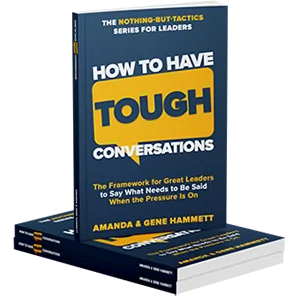
[24:26] Yeah, I agree with you. We wrote the book on how to have tough conversations if anybody’s interested. And Adam Grant has a great line in there. I think he calls it like 18 words or something. And I’m paraphrasing when I say this, but like the reason why I’m giving you this feedback is because I know I expect that you can handle it and something to that effect. And that is that is such a powerful frame to get someone to think beyond the level they are now. Whatever the issue is. Like, we got one more question that we can wrap up this. And I always say, I always get curious and ask one more after that.
Gene Hammett:
[25:05] But I will tell you, you mentioned leverage, the long game. What is the long game as it relates to exponential growth?
Blake Erickson:
[25:16] I think it’s building an asset that compounds. And I think all the actions that you take today eventually have some form of compound effect. The way your culture is, the way you treat your employees today, the people you hire, the decisions you make, the direction you go with product, your interactions with customers. Although sometimes it may seem really short term, it might be like a one-off experience. I promise you those things do come back and they compound. And there is a long-term game to each one of those aspects. So the game of exponential growth is to build an asset so incredible that it can compound by itself and keep scaling.
Gene Hammett:
[25:54] I told you I might sneak one more question in here, but this is the final question. Is there anything I missed in this whole concept of a founder that leads exponential growth?
Blake Erickson:
[26:06] No, I think you nailed it. You truly are, as the founder, you truly are the biggest lever for scale or stagnancy in your company. And so that’s a lot of weight on your shoulders, but that’s the burden we bear as we choose to be founders of companies. I would just say, Gene, for any of you that haven’t read the book, The Science of Scaling, we have a free copy for each of you. If you go to scaling.com forward slash free download, please download that. It’s completely free. And you can fill in any of the gaps that Gene and I might have missed.
Gene Hammett:
[26:39] Fantastic. Blake, thanks for being here.
Blake Erickson:
[26:41] I appreciate you, Gene.
Gene Hammett:
[26:43] Wow, what a great interview. I loved the back and forth that we had there. Hopefully, you enjoyed it as well. Hopefully, you are able to avoid the mistakes that we talked about. Hopefully you are able to think about those core principles of attracting A players, about truly being able to pivot where necessary and focus on the right thing. And how do you leverage for the long game? Those are critical elements. No matter where you are in your business, I think you can use those to move to that next level and then can keep that momentum growing with the right team and the right leadership. If we can help you in any way, make sure you let me know. If you want to download any of our books, just go to coreelevation.com. You’ll be offered the things and the tools that will help you grow your business. And if you’re curious about just having a conversation with me, I’m happy to do that. Just go to coreelevation.com and you can register for a conversation with me absolutely for free. That being said, have a fantastic day. And when you think of growth and you think of leadership, think of growth, think tank. As always, leave with courage. We’ll see you next time. Thank you.
How to Connect with Blake Erickson
Learn more about Blake Erickson and his work helping entrepreneurs achieve exponential business growth.
🌐 Website: https://scaling.com
👤 Personal Website: https://blakeerickson.com
💼 LinkedIn: https://www.linkedin.com/in/blake-erickson-756b54168/
📸 Instagram: @theblakeerickson
Resources & Next Steps
Ready to take your leadership energy to the next level?
Explore free training and resources at training.coreelevation.com to help you identify energy leaks, strengthen your leadership presence, and elevate your team’s performance.
🌐 Explore More: training.coreelevation.com
🎧 Listen to the Full Episode: Growth Think Tank Podcast